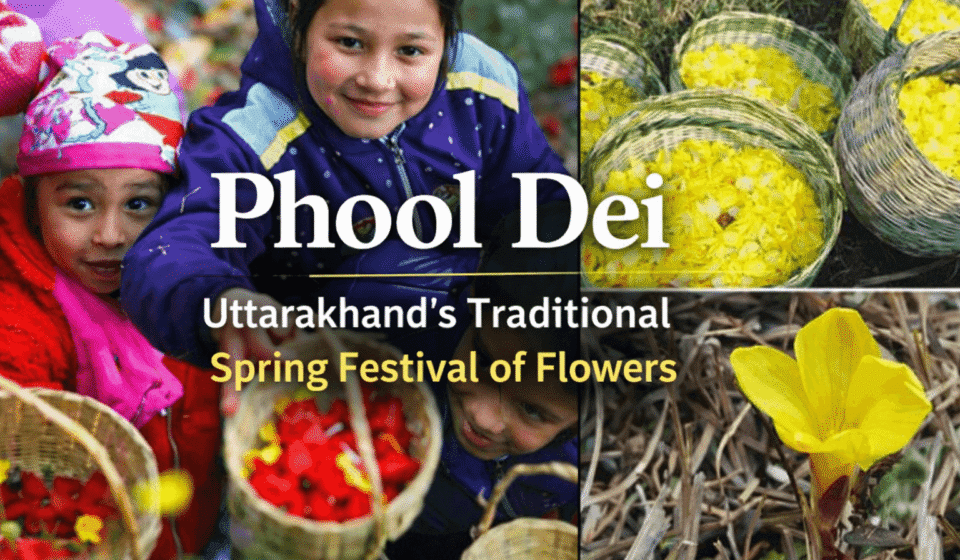

The end of a Himalayan winter is a quiet affair. It is found in the way the light changes and the air warms just enough to breathe easily. Across the slopes of Uttarakhand, the mountain’s architecture changes; the first Buransh begins to glow against the green, and the delicate Fyonli wakes up along the stone-walled terraces, marking the start of a cycle that is as much about the spirit as it is about the soil.”
Around this time, on the first day of the Hindu month of Chaitra, villages across Uttarakhand observe Phool Dei, the traditional spring festival of the region. There are no loud processions. No decorated stages. The festival begins at the doorstep level.
What Phool Dei Means
The word is simple: Phool – flower and Dei – to offer or place ceremonially.
Phool Dei marks the beginning of the New Year in many hill communities. It is also considered a harvest-linked observance, acknowledging the agricultural cycle that will soon begin.
Unlike temple-centric festivals, Phool Dei is led by children. For this reason, it is often called Lok Bal Parv, the people’s children’s festival.
The ritual is modest, but its structure is deliberate. It brings together season, land, and community in one small act.
The Legend of Princess Pyoli (Fyonli)
Local folklore adds another layer to the festival.
One popular story speaks of Princess Pyoli, a young woman married away from her mountain home. Unable to adjust to the plains, she longed for the forests and slopes of her childhood. After her death, villagers believed she returned as the yellow Fyonli flower that blooms each spring.
The story is still narrated in parts of Garhwal and Kumaon. Whether taken as legend or metaphor, it explains why yellow blossoms are often used during Phool Dei. The flower represents attachment to land and belonging.
Like many Himalayan tales, the story is not written in scriptures. It survives through repetition.
The Ritual: How Phool Dei Is Observed
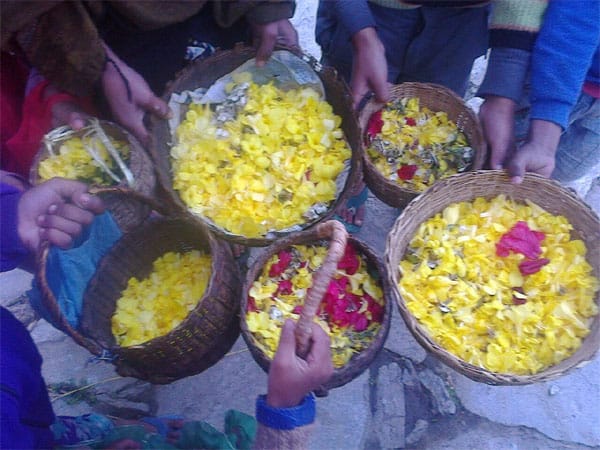
- Gathering Flowers: At dawn, children called Phoolyari step out to collect fresh spring flowers. These may include: Buransh, Fyonli, and other locally available wild blooms.
Traditionally, flowers are picked in small quantities. The emphasis is on participation, not display. They are carried in small baskets, sometimes woven from ringal (mountain bamboo).
- The Doorstep Offering: Children go from house to house in their village. At each home, they place flowers and a small amount of rice on the dehri, the threshold.
The threshold is symbolically important in Himalayan homes. It marks entry and protection. Placing flowers there is a gesture of goodwill and blessing.
As they place the flowers, children sing a traditional line:
“Phool Dei, Chamma Dei,
Deno Dwar, Bhur Bhakar…”
A commonly understood meaning is:
“May your doorway be blessed,
May your granaries remain full.”
After the offering, families give rice, jaggery, sweets, or small coins to the children. This exchange reinforces community ties.
Ghogha Mata and Child-Led Worship
In some villages, children also invoke Ghogha Mata, a localised protective figure associated with flowers and seasonal well-being. The worship is informal and child-led, without elaborate ritual structure.
Phool Dei remains one of the few festivals where authority rests primarily with children.
The Final Day: Departure of Ghogha Mata
In several villages of Garhwal, Phool Dei closes with a small, deliberate ritual centred on Ghogha Mata, a localised guardian figure associated with flowers and seasonal protection.
Throughout the days of the festival, the Phoolyaris collect rice, jaggery, and small offerings from each household they visit. On the final day, these contributions are pooled together. The children prepare a simple communal bhog. There is no excess. The act of cooking together is part of the observance.
The Phoolyaris decorate a small dola (palanquin) with flowers gathered from nearby fields and forest edges. The prepared food is placed before the goddess. The ritual is informal, often guided by memory rather than written instruction.
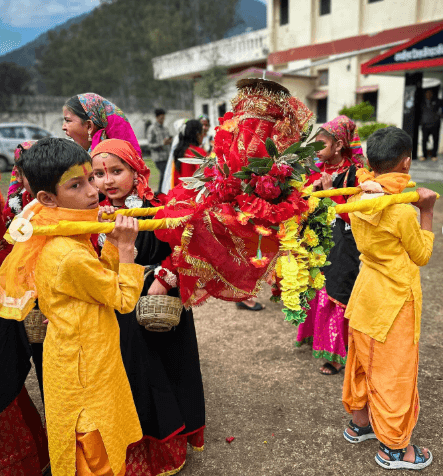
With this final act, the seasonal welcome is complete. Spring has been acknowledged, homes have been blessed, and the exchange between households has run its course.
Phool Dei ends the way it began: without spectacle. The festival leaves no permanent structure behind, only a memory of participation. When Chaitra returns the following year, the cycle will begin again.
Why Phool Dei Continues
In many towns, the festival has reduced in scale. Migration, schooling patterns, and urban schedules have changed how children participate.
Yet in numerous villages across Uttarakhand, the practice continues with minimal alteration. No banners are required. No external validation is needed.
Phool Dei persists because it fits the landscape. It teaches children the names of flowers. It reinforces seasonal awareness. It encourages exchange without transaction.
Most importantly, it marks the New Year not with noise, but with acknowledgement. In the hills, that is often enough.
Frequently Asked Questions on Phool Dei Festival
Q1. What is Phool Dei? Or Phool Sankranti
Phool Dei is a spring festival celebrated in Uttarakhand on the first day of Chaitra. It is also known as Phool Sankranti. Children place fresh flowers on doorsteps and offer blessings for prosperity and a good agricultural year.
Q2. When is Phool Dei celebrated in 2026?
In 2026, Phool Dei (Phool Sankranti) will be observed around March 14–15, marking Chaitra Sankranti and the traditional New Year in the hills.
Q3. Who are the Phoolyaris?
Phoolyaris are the children who lead the festival. They gather seasonal flowers and visit homes to place them at the threshold while singing traditional blessing songs.
Q. What is the meaning of the Phool Dei song?
The song “Phool Dei, Chamma Dei…” expresses wishes for full granaries, prosperity, and well-being for each household.
Q5. What food is prepared during Phool Dei?
Simple dishes like Sei or Meetha Bhaat are central to the festival. While Sei is crafted from rice flour, curd, and jaggery, Meetha Bhaat (Sweet Rice) is a preparation of rice sweetened with jaggery. Both are shared as a communal offering. The choice between the two depends entirely on the region; some parts of Uttarakhand prepare Sei, while others favour Meetha Bhaat.