
The walk to Chandrashila begins where Tungnath ends. Past the temple, the trail narrows, the air sharpens, and the landscape sheds its shelter. Trees fall away. Wind takes over. What remains is a steady climb toward exposure.
Chandrashila is not a place of arrival in the usual sense. It is a place where perspective widens faster than breath and where the Himalayas stop framing the view and become the view itself.
What Chandrashila Is and Is Not
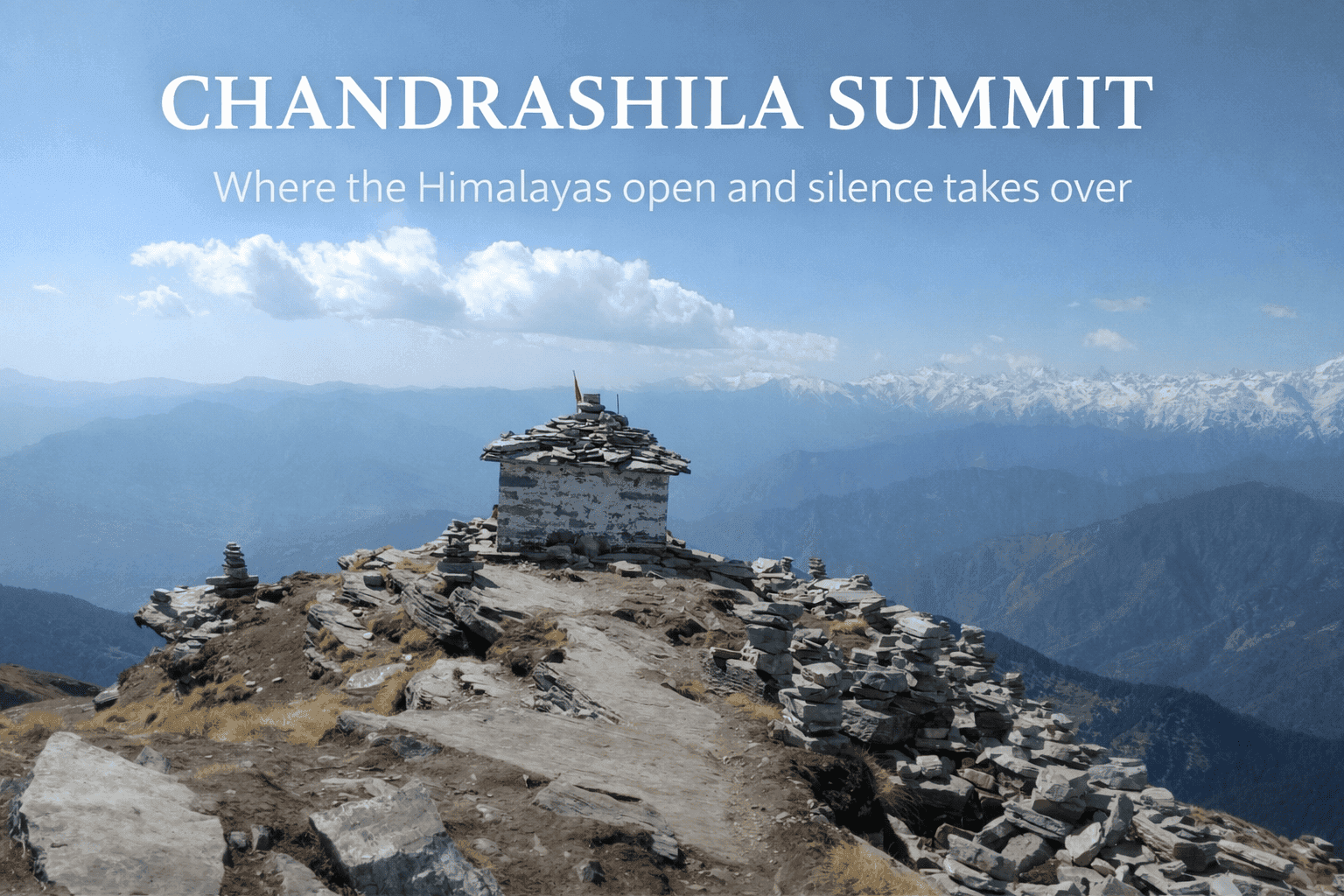
Chandrashila is a rocky summit that rises above Tungnath, accessible by a short but demanding ascent. It is often described as a viewpoint, but that description is somewhat misleading.
There are no structures here. No markers of completion. Just a narrow crest of stone where the mountains open outward in all directions.
On clear days, peaks like Nanda Devi, Chaukhamba, Trishul, Kedarnath, and Bandarpunch stand in long succession not as highlights, but as presence.
The Final Ascent
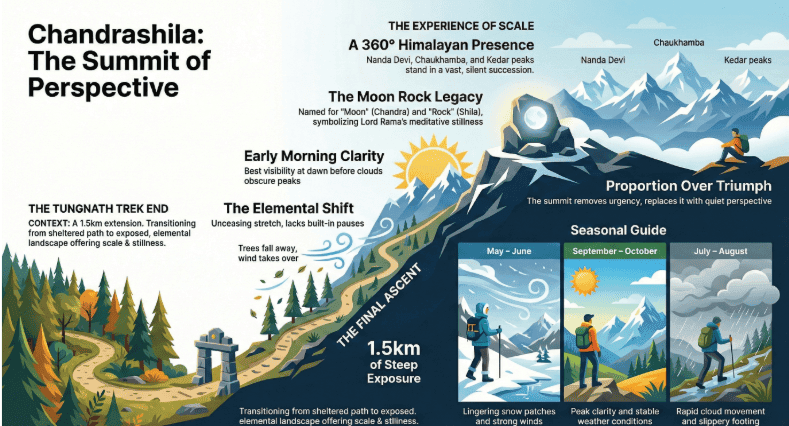
From Tungnath, Chandrashila lies about 1.5 kilometres uphill. The distance is short, but the effort is unmistakable. The trail steepens. Wind moves unchecked. Breathing grows deliberate. Each step asks for attention.
Unlike the walk to Tungnath, this stretch feels less ceremonial and more elemental. There are no pauses built into the path. You climb until the land no longer rises.
At the Top
The summit of Chandrashila is narrow and exposed. There is little space to linger comfortably, and the wind makes that clear.
People speak less here. Some sit quietly. Others stand, facing outward, not sure where to look first. The scale resists narration. Chandrashila does not reward you with triumph. It offers proportion.
Myth and Meaning
According to tradition, Chandrashila is associated with Lord Rama, who is believed to have meditated here after defeating Ravana. The name itself, Chandra (moon) and Shila (rock), carries echoes of stillness rather than conquest.
Whether one arrives with belief or without it, the summit does not insist on interpretation. It allows space for it.
When to Walk to Chandrashila
Chandrashila follows the same seasonal rhythm as Tungnath.
- May to June: snow patches remain, winds are strong
- September to October: clearest views, stable weather
- July–August: clouds move quickly; footing can be slippery
- November to April: the trail is usually inaccessible due to snow
Early mornings offer the best clarity, before clouds begin to rise.
Knowing When to Stop
Not everyone who reaches Tungnath continues to Chandrashila. And that choice is worth respecting.
Chandrashila is not a requirement. It is an extension of effort, of exposure, of perspective. For some, the temple is the natural end. For others, the summit completes the arc.
Both endings are valid.
Coming Down
The descent from Chandrashila returns you quickly to Tungnath, and then gradually back to Chopta. The body relaxes. Sounds return. Trees reappear.
What stays is not the height, but the quiet recalibration of the sense that the world below will feel slightly louder, slightly faster, than before.
Chopta, Tungnath, Chandrashila: A Single Landscape
Taken together, these three places form a continuous journey.
- Chopta offers ground.
- Tungnath offers stillness.
- Chandrashila offers scale.
They are not separate destinations. They are different states of the same landscape.
Why Chandrashila Is Remembered
Many summits are remembered for the effort it takes to reach them. Chandrashila is remembered for what it removes.
Up here, urgency thins out. Perspective widens. The need to explain fades. The Himalayas do not grow louder at this height. They grow vast and silent.