Panch Prayag Explained: 5 Sacred River Confluences of Uttarakhand

In the mountains of Uttarakhand, journeys are rarely straight. Roads curve, valleys open and close, and rivers change character without warning. If you travel along the Alaknanda long enough, you begin to notice something specific: it doesn’t remain the same river.
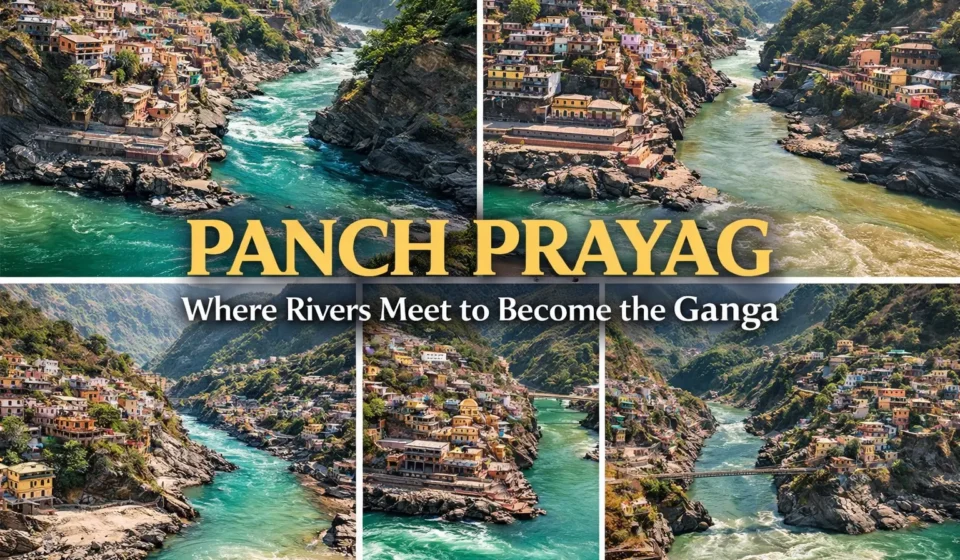
At different points, other rivers join it. Not quietly, not invisibly, but in ways that alter its volume, speed, and direction. These meeting points are known as the Panch Prayag.
This is not just a set of five locations. It is a continuous transformation of a river becoming the Ganga.
This journey also connects closely with the sacred Badri temples of the region. If you want to understand how these landscapes are spiritually mapped, explore our guide to Panch Badri in Uttarakhand.
What Panch Prayag Actually Means
The term Prayag refers to a confluence of rivers. In the Himalayan context, these confluences are not just geographic features; they are treated as places of transition. When two rivers meet, the combined flow is seen as more significant than the individual streams.
The Panch Prayag are five such confluences along the Alaknanda River:
- Vishnuprayag
- Nandaprayag
- Karnaprayag
- Rudraprayag
- Devprayag
Each one adds a new river to the system. By the time the Alaknanda reaches the final confluence, it has absorbed multiple tributaries and becomes the Ganga.
Understanding Panch Prayag is not about memorising names. It is about following this sequence and observing how each meeting changes the river.
Each of these confluences can also be explored individually. Detailed guides on Vishnuprayag, Nandaprayag, Karnaprayag, Rudraprayag, and Devprayag will help you understand their local geography, access points, and travel nuances.
The Larger Context: How the Ganga Forms
The Ganga does not begin as a single stream. It forms when two major Himalayan rivers, Alaknanda and Bhagirathi, meet at Devprayag.
Before that happens, the Alaknanda travels a long distance and meets four other rivers:
- Dhauliganga at Vishnuprayag
- Nandakini at Nandaprayag
- Pindar at Karnaprayag
- Mandakini at Rudraprayag
Each confluence increases the river’s size and changes its behaviour. By the time it reaches Devprayag, the Alaknanda is no longer what it was near its source.
1. Vishnuprayag: Where the Journey Starts with Force
This is the first Prayag, and it sets the tone immediately. The rivers meet in a narrow, steep valley. The flow is fast, and the sound of water is constant. There is no gradual merging here; the Dhauliganga enters with force.
From a travel perspective, this location feels remote. It is slightly off the main highway, and many people pass through Joshimath without stopping here.
💡 It is believed that Sage Narada meditated here and was blessed by Lord Vishnu. The name Vishnuprayag emerges from this association.
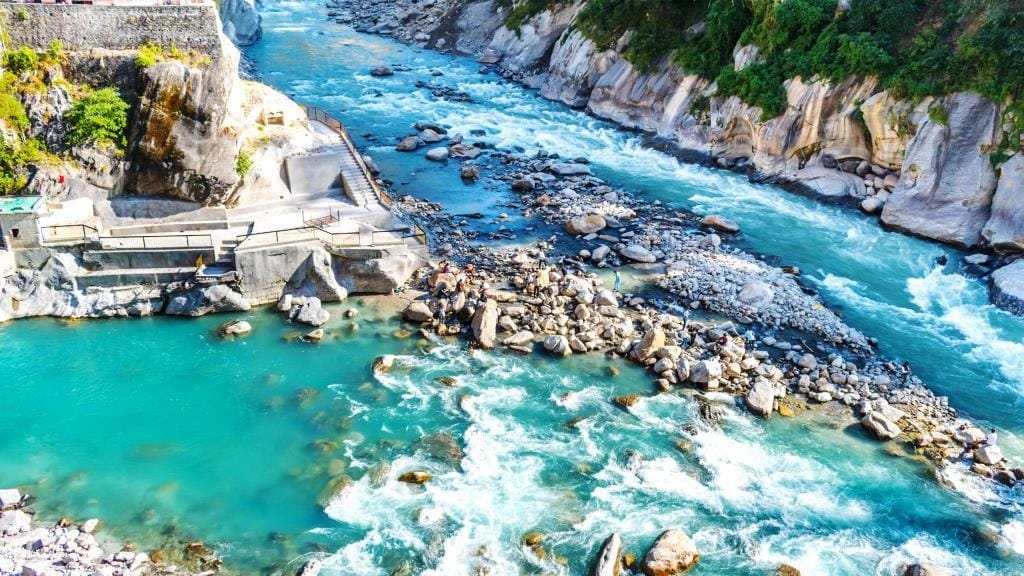
What Changes Here
- The Alaknanda gains volume quickly
- The flow becomes more aggressive
- The terrain around the river is sharply cut
Why It Matters
Vishnuprayag shows the river at its most energetic. It is early in the journey, and the river is still responding to steep gradients and narrow valleys.
Vishnuprayag is also closely linked to the Badrinath region. If you are travelling further, read our complete guide on Badrinath Temple.
2. Nandaprayag: Where the Pace Slows Down
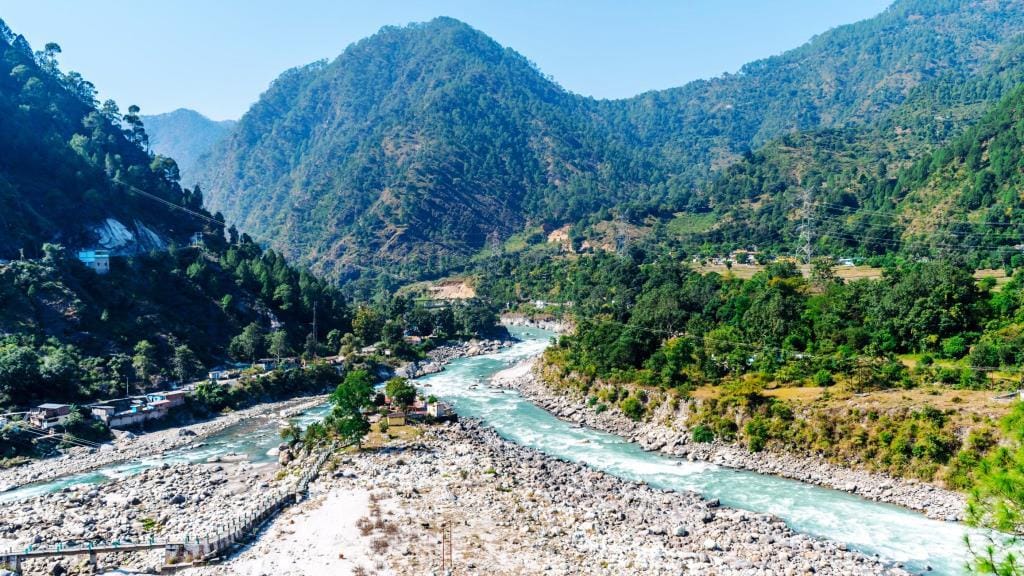
Further downstream, the river reaches Nandaprayag, where the Nandakini joins the Alaknanda.
The difference is noticeable. The valley is wider, the flow is less turbulent, and the surrounding town is more integrated with the landscape. Instead of steep rock faces, you see settlements, roads, and daily life closer to the river.
💡 It is believed that King Nanda performed a yajna at this site, giving the confluence its name.
What Changes Here
- The river spreads slightly across a broader valley
- The flow stabilises compared to Vishnuprayag
- Human settlements become more visible
Why It Matters
Nandaprayag introduces balance. After the intensity of Vishnuprayag, this confluence shows how the river begins to adapt to changing terrain.
3. Karnaprayag: Where the River Gains Depth
At Karnaprayag, the Pindar River joins the Alaknanda.
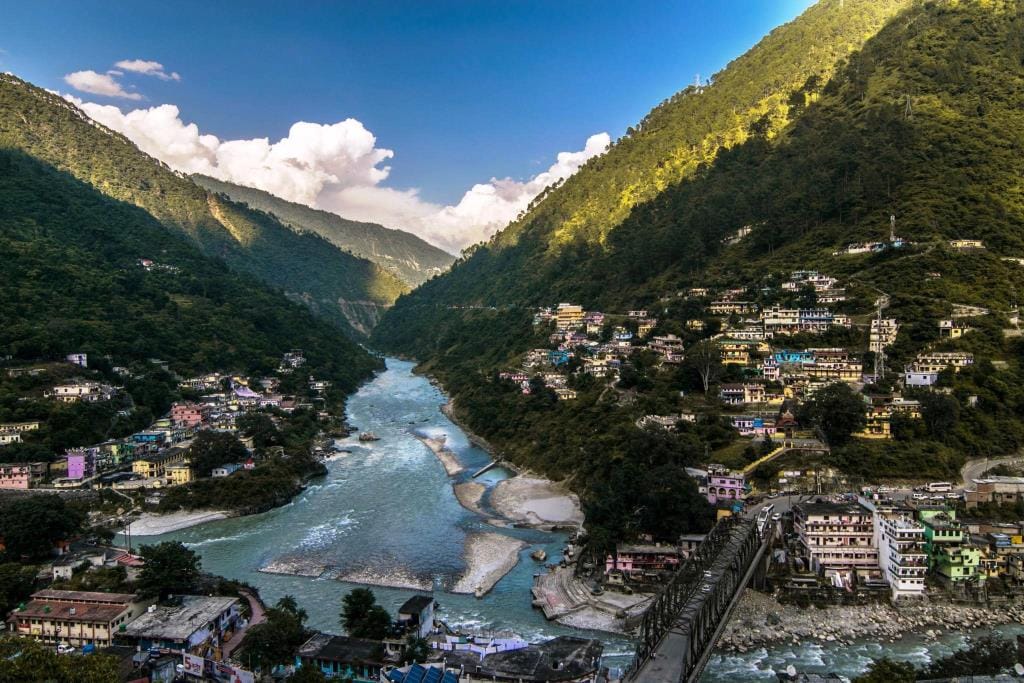
This confluence feels different again. The Pindar carries significant sediment from glacier regions, which gives the water a heavier appearance. The valley here is wider, and the town is more active compared to previous Prayags.
💡 Karnaprayag is associated with Karna. It is believed he meditated here and received divine armour. But even without this context, the geography itself stands out.
What Changes Here
- The river becomes visibly denser due to sediment
- The valley opens further
- The confluence feels more grounded than dramatic
Why It Matters
Karnaprayag is where the river begins to feel substantial, not just fast-moving water, but a system carrying material, force, and scale.
4. Rudraprayag: Where Two Important Routes Meet
Rudraprayag is one of the most well-known confluences, partly because of its location.
Here, the Mandakini River meets the Alaknanda. The Mandakini comes from the Kedarnath region, making this confluence important for pilgrims travelling between major Himalayan temples.
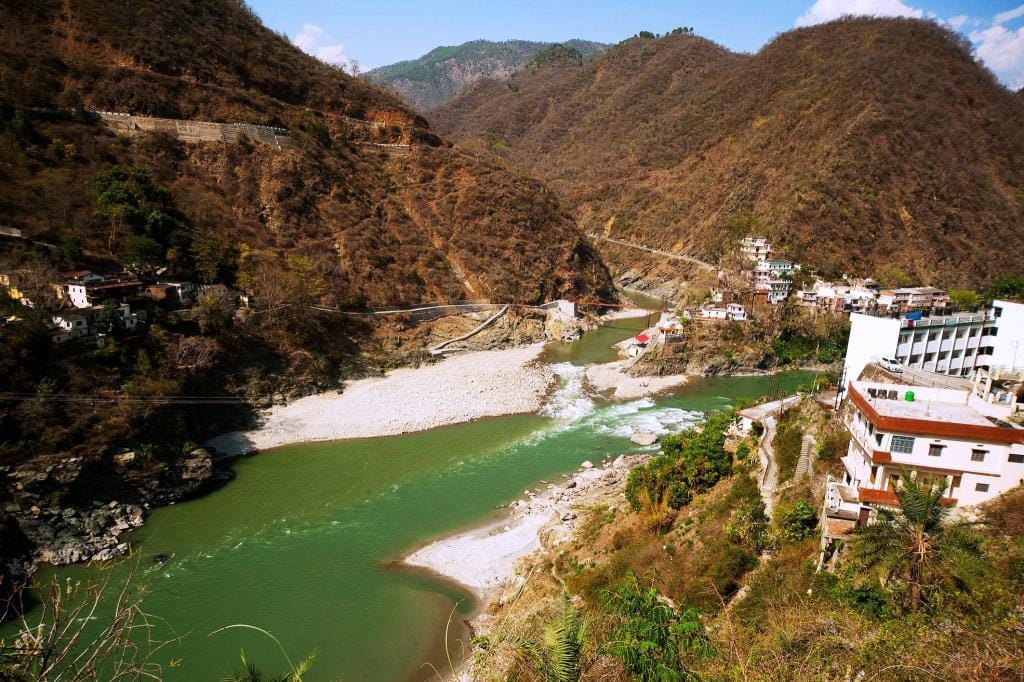
The meeting point is sharp and clearly visible. The two rivers approach from different angles and merge distinctly.
💡 Named after Lord Shiva in his Rudra form, this place is believed to be where Shiva appeared to bless Narada.
What Changes Here
- The river gains additional volume from a major tributary
- The confluence is visually pronounced
- The area becomes a key travel junction
Why It Matters
Rudraprayag is not just a geographic point; it is a functional one. Roads diverge here toward Kedarnath and Badrinath, making it an important stop for travellers.
From Rudraprayag, one route leads toward Kedarnath, making it a crucial junction in the Char Dham Yatra. You can read our detailed guide on the Char Dham Yatra route before planning further.
5. Devprayag: Where the Name Changes
At Devprayag, the journey reaches its most important transition.
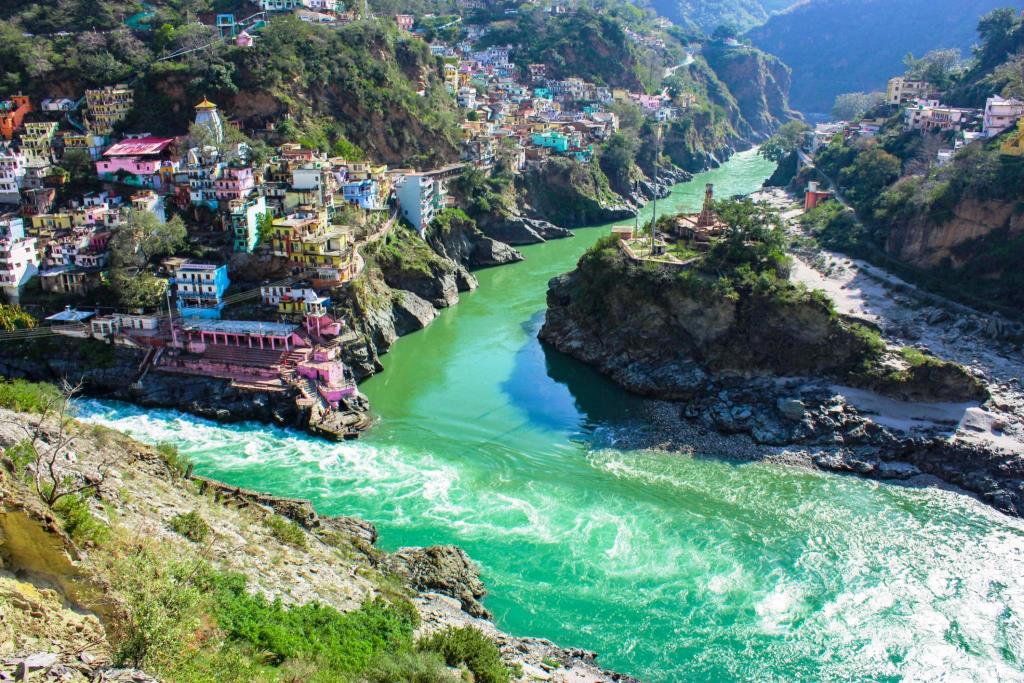
Here, the Alaknanda meets the Bhagirathi. After this point, the river is no longer called Alaknanda; it becomes the Ganga.
From here onward, the river flows toward Rishikesh and Haridwar, shaping some of the most important spiritual centres in India. If you are continuing downstream, explore our guide to Rishikesh travel and river experiences.
This is not symbolic naming. It is officially recognised as the Ganga’s origin. While the Bhagirathi is culturally considered the “source” of the Ganga (coming from Gaumukh/Gangotri).
You can clearly see the difference between the two rivers before they merge:
- The Bhagirathi appears darker and faster
- The Alaknanda appears broader and slightly lighter
Once they meet, the combined flow continues as a single river.
Located near Rishikesh, Devprayag is also the most accessible of all five Prayags.
💡 It is named after sage Dev Sharma, who is believed to have meditated here.
What Changes Here
- The river’s identity changes
- The combined flow becomes the Ganga
- The journey of Panch Prayag concludes
Why It Matters
Devprayag is the endpoint of the Panch Prayag sequence. Everything upstream contributes to this moment.
Seeing Panch Prayag as One Continuous Journey
Most travel guides treat Panch Prayag as separate destinations. That approach misses the main point.
The five Prayags are connected. They follow the same river, in a fixed sequence:
Vishnuprayag → Nandaprayag → Karnaprayag → Rudraprayag → Devprayag
If you travel from Rishikesh toward Badrinath, you encounter them in reverse order.
What makes this journey meaningful is not visiting all five, but noticing how the river changes between them.
Travel Planning: How to Cover Panch Prayag
Starting Point: Most journeys begin from Rishikesh, which is well connected by road and rail.
Suggested Route (3 Days)
- Day 1: Rishikesh → Devprayag → Rudraprayag
- Day 2: Rudraprayag → Karnaprayag → Nandaprayag
- Day 3: Nandaprayag → Vishnuprayag → Joshimath
This route follows the river upstream, allowing you to experience the gradual transitions.
Best Time to Visit
Recommended Seasons
- April to June: Stable weather, clear roads
- September to November: Best visibility after the monsoon
Avoid
- Monsoon (July–August): Landslides and high river flow
- Peak Winter: Snow can restrict access beyond certain points
Practical Travel Tips
- Roads are mostly mountain highways, expect curves and variable conditions
- Start early each day to avoid weather changes in the afternoon
- Fuel stations are limited in the upper regions; plan accordingly
- Mobile network may drop in certain stretches
Why Panch Prayag Is Still Relevant
It is easy to reduce Panch Prayag to a religious checklist or a travel itinerary. But its relevance is broader.
It offers a clear example of how rivers are formed, not from a single source, but through accumulation.
Each confluence adds:
- Water
- Sediment
- Momentum
By the time the river becomes the Ganga, it is already the result of multiple systems coming together.
This is visible, not theoretical. You can stand at each Prayag and see the change happen.
FAQs: Panch Prayag
Q1. What are the five Prayag in Uttarakhand? Vishnuprayag, Nandaprayag, Karnaprayag, Rudraprayag, and Devprayag.
Q2. Which rivers meet at Devprayag? The Alaknanda and Bhagirathi rivers.
Q3. How many days are needed to cover Panch Prayag? Typically 2–4 days, depending on pace.
Q4. Is Panch Prayag part of the Char Dham Yatra? Yes, it lies along the route to Badrinath.
Q5. Which Prayag is most accessible? Devprayag is due to its proximity to Rishikesh.

NativeSteps
We believe the best stories are found off the beaten path and under an open sky. NativeSteps is dedicated to mindful exploration, helping you navigate the world with a lighter footprint and a deeper connection to the places you visit. Every step is an opportunity to honour the earth and the cultures that call it home.