


At 3,583 metres in Uttarakhand’s Rudraprayag district, where roads dissolve into mountain paths, and peaks overtake the sky, Kedarnath Temple endures, a meeting point of faith, stone, and the raw force of the Himalayas.
In the Shadow of Kedar Dome
In the upper reaches of Uttarakhand’s Rudraprayag district, where roads gradually disappear, and altitude begins to dictate movement, Kedarnath Temple stands in quiet defiance of time. Resting at approximately 3,583 metres (11,755 feet), the shrine lies deep within the Kedar Valley, surrounded by glacial streams, moraine fields, and towering Himalayan walls.
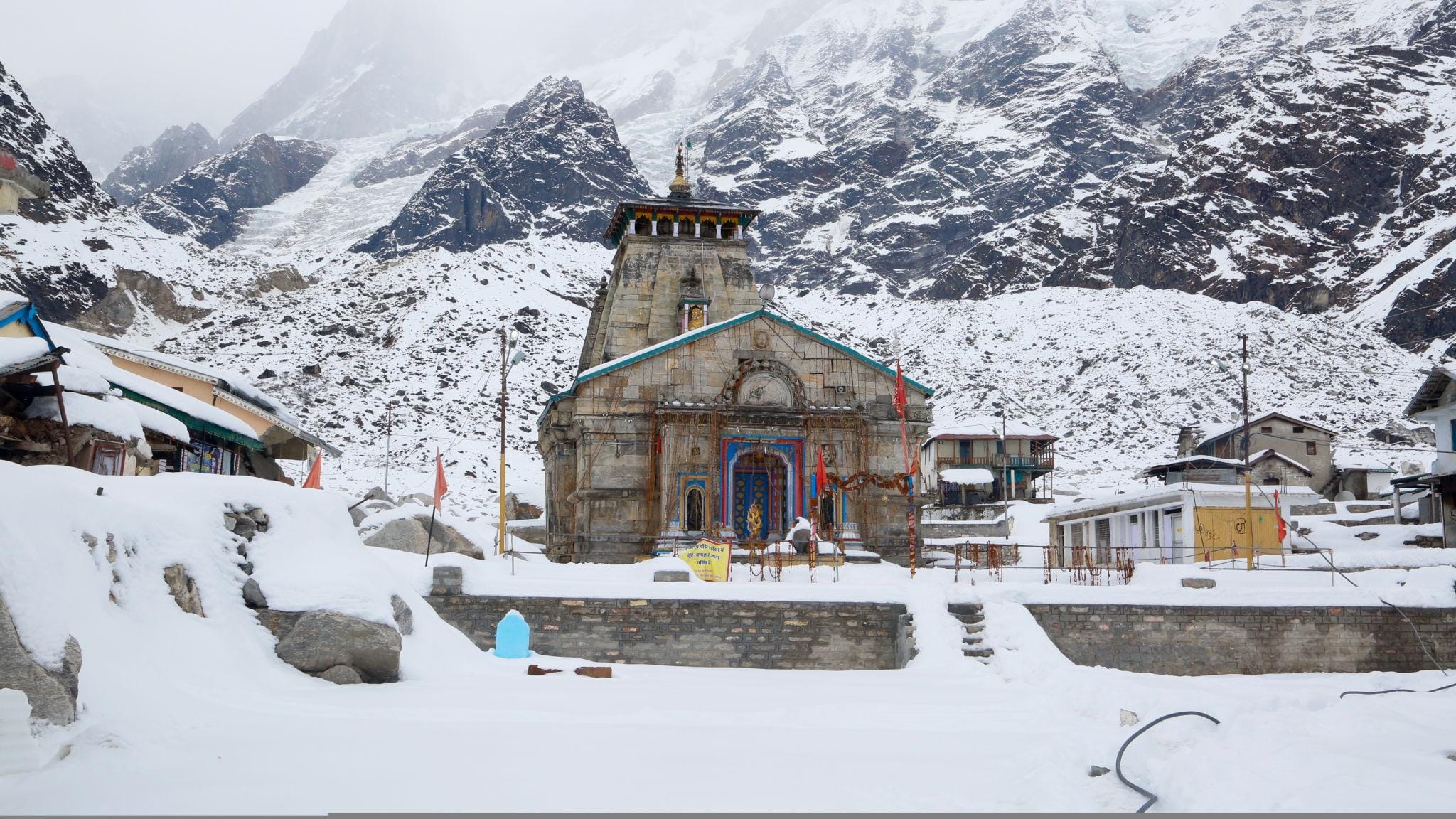
It is one of the twelve Jyotirlingas of Lord Shiva and one of the four sacred shrines of the Chota Char Dham Yatra. Yet Kedarnath feels unlike most temples in India. There is no ornate spectacle here. No polished symmetry. Only endurance.
The first glimpse often arrives after hours of ascent: grey stone against snow-lined peaks, prayer flags shifting in thin air. Behind the temple rises Kedar Dome (6,940 m), silent and watchful.
The Pandavas and the Hidden God
According to ancient tradition, after the Mahabharata war, the Pandavas sought forgiveness from Lord Shiva. Shiva, unwilling to absolve them easily, retreated into the Himalayas disguised as a bull.
When Bhima attempted to seize him, the bull is said to have disappeared into the earth. Parts of Shiva’s body re-emerged in five locations across Garhwal, forming the sacred Panch Kedar:
- Kedarnath – the hump
- Tungnath – the arms
- Rudranath – the face
- Madhyamaheshwar – the navel
- Kalpeshwar – the hair
Kedarnath, marking the hump, is considered the most significant of the five. For centuries, pilgrims have believed that worship here lightens karmic burdens and draws the soul closer to moksha.
Adi Shankaracharya and the Living Tradition
The present stone structure is traditionally attributed to Adi Shankaracharya in the 8th century CE, who revitalised pilgrimage routes across India. Some scholars suggest earlier forms of worship may have existed here before the current temple was constructed.
Just behind the shrine lies Shankaracharya’s samadhi. Whether history or devotion guides belief, his presence adds another layer of stillness to the valley.
Kedarnath also preserves a unique priestly tradition. The head priest, known as the Rawal, belongs to the Veerashaiva community of Karnataka, a centuries-old practice reflecting spiritual continuity across regions.
Architecture: Built to Withstand the Elements
Kedarnath is often described as miraculous, not for intricate carvings, but because it continues to stand in one of the harshest pilgrimage environments in the world.
Stone Without Mortar
Constructed in the Panch Rath style, the temple is built from massive interlocking grey stone slabs assembled without mortar. Each block was cut and placed with remarkable precision, considering the altitude and terrain.
The temple faces south, unusual in Hindu architecture, possibly designed to withstand avalanches and glacial winds from the north. Its pyramidal roof prevents heavy snow accumulation, allowing it to endure extreme winters.
The Sanctum
Inside the garbhagriha, devotees worship a natural, triangular rock formation, a Swayambhu lingam representing Shiva in his Sadashiva form. The chamber is dimly lit by oil lamps. Conversations soften. Even hurried thoughts begin to slow.
Nandi and Bhairav
A stone Nandi bull sits opposite the entrance. Pilgrims whisper prayers into Nandi’s ears, believing the message reaches Shiva directly.
About 500 metres uphill stands the Bhairavnath Temple, dedicated to Bhairav, considered the guardian deity of Kedarnath. Local belief holds that the pilgrimage remains incomplete without visiting this shrine.
The Walk from Gaurikund
The pilgrimage begins at Gaurikund (1,982 m), the last motorable point. From here, the trek to Kedarnath stretches approximately 16–18 kilometres along a reconstructed route built after the 2013 floods.
The path climbs nearly 1,600 metres in elevation, running alongside the Mandakini River.
Pilgrims may:
- Walk the entire route
- Hire a pony or horse
- Travel by palanquin (doli)
- Take a helicopter from Phata, Guptkashi, or Sersi (weather permitting)
Yet many still choose to walk. For them, the ascent itself becomes prayer.
The 2013 Floods and the
In June 2013, catastrophic floods devastated the Kedar Valley. Entire settlements, including Rambara, were washed away.
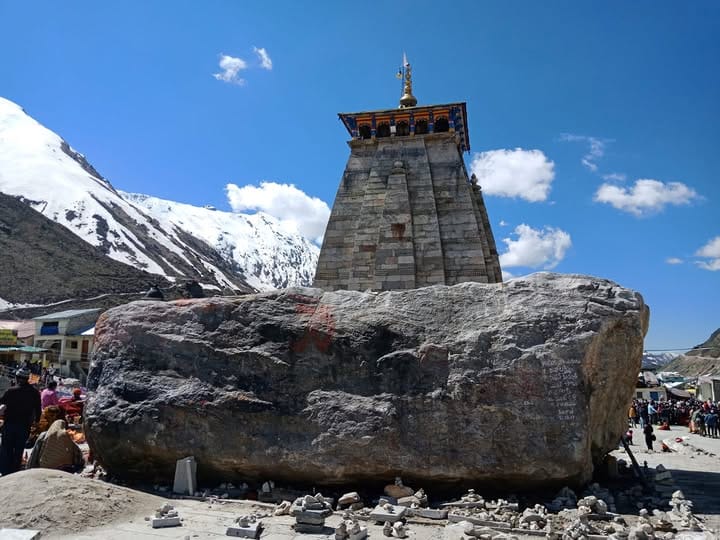
Yet the temple remained standing. A massive boulder, now known as the Bhim Shila, lodged itself behind the shrine, diverting the force of debris. For believers, it symbolised protection. For others, resilient engineering and geological chance.
Seasonal Rhythm: When the Mountains Decide
Kedarnath remains open only from late April until October or early November, depending on snowfall.
- The opening date is traditionally announced on Maha Shivaratri.
- The closing takes place around Bhai Dooj.
During winter, heavy snow buries the valley. The deity is ceremonially moved to the Omkareshwar Temple in Ukhimath, where worship continues until spring.
How to Reach Kedarnath Temple
Most pilgrims begin from Haridwar, Rishikesh, or Dehradun.
- By air: Jolly Grant Airport (Dehradun)
- By train: Haridwar and Rishikesh railway stations
The road journey follows the Alaknanda and Mandakini valleys through Devprayag and Rudraprayag toward Sonprayag and Gaurikund. From Gaurikund, the ascent begins. Weather conditions can shift rapidly. Patience is part of the pilgrimage.
Best Time to Visit Kedarnath
Kedarnath is not accessible year-round. The mountains decide the calendar.
- May–June: Clear skies, stable trekking conditions, peak crowds.
- July–August: Monsoon; landslide risks increase.
- September–October: Fewer visitors, clearer views, colder nights.
- November–April: Temple closed; worship continues at Ukhimath.
Before You Go
- Registration for the Char Dham Yatra is mandatory via the Uttarakhand government portal.
- Carry a valid ID proof.
- Pack layered clothing, rain protection, and sturdy trekking shoes.
- Acclimatise when possible.
- Respect the fragile Himalayan ecosystem.
- The mountains are not merely scenery here. They are authority.
Frequently Asked Questions About Kedarnath Temple
Q1. Where is the Kedarnath Temple located?
Kedarnath Temple is located in the Rudraprayag district of Uttarakhand at an altitude of 3,583 metres in the Garhwal Himalayas. It is accessible by a mountain trek from Gaurikund.
Q2. How long is the Kedarnath trek?
The trek from Gaurikund to Kedarnath is approximately 16–18 kilometres and usually takes 6–9 hours on foot.
Q3. When does Kedarnath Temple open and close in 2026?
The temple is set to open its doors on April 22, 2026, at 8:00 AM. The closing date is determined by the lunar calendar but typically falls on November 6, 2026 (Bhai Dooj). After this, the valley becomes inaccessible due to heavy snow.
Q4. Is registration required for the Kedarnath yatra in 2026?
Yes. Mandatory biometric registration is required through the official Uttarakhand Tourism portal or at designated checkpoints. Pilgrims receive a Yatra pass that is verified along the route.
Q5. Is the Kedarnath trek difficult?
The trek involves a steady climb of nearly 1,600 metres in elevation. While manageable for most healthy pilgrims with preparation, proper pacing and acclimatisation are important.
Q6. What is the Bhim Shila at Kedarnath?
The Bhim Shila is a large boulder that came to rest behind the temple during the 2013 floods, helping divert debris away from the shrine.
Q7. Can Kedarnath be visited in winter?
No. The temple remains closed from November to April due to heavy snowfall. Worship continues at the Omkareshwar Temple in Ukhimath.