
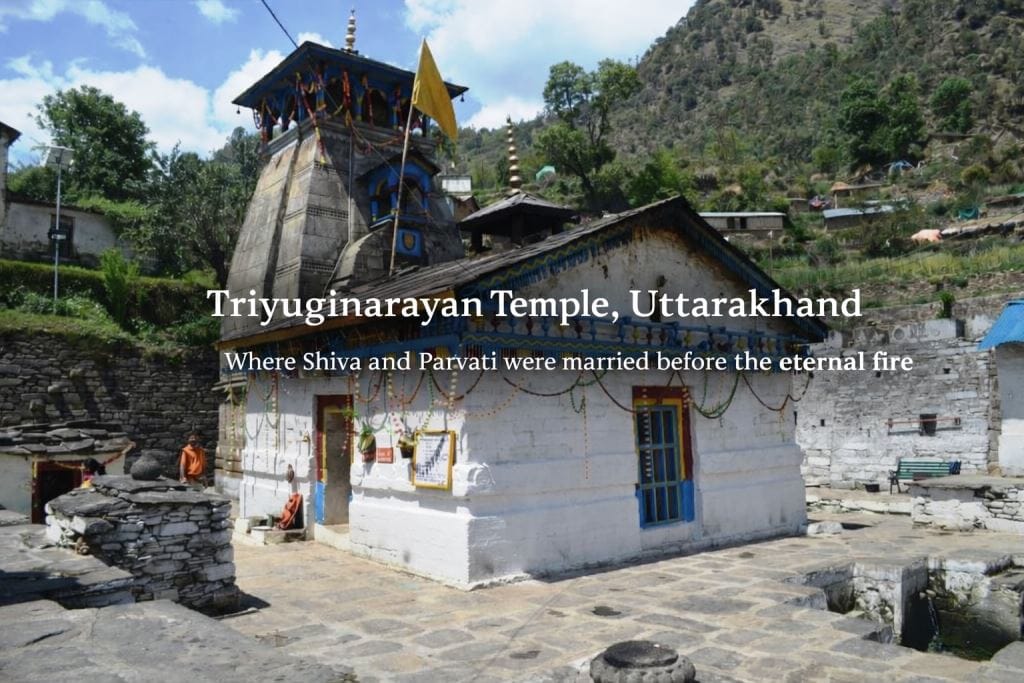

The Triyuginarayan Temple is one of those places that doesn’t announce its importance. There are no grand gates, no swelling crowds, no sense of arrival. You reach the village quietly, and only later realise that you are standing in a landscape that holds one of the most enduring stories in Hindu tradition.
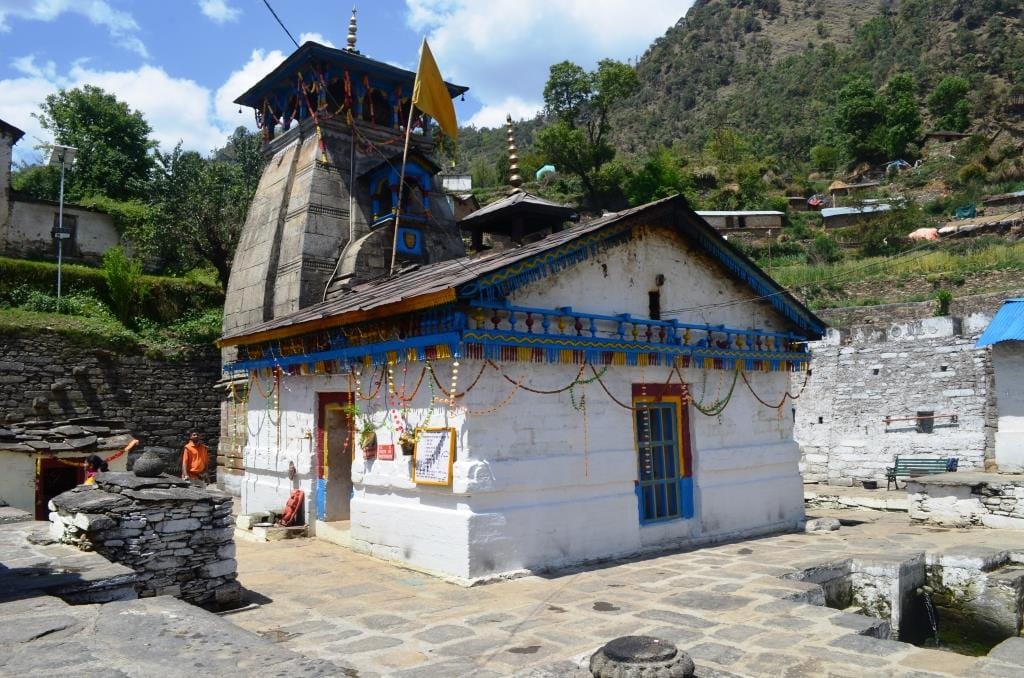
Set in a small settlement in Uttarakhand’s Rudraprayag district, Triyuginarayan is renowned as the site where Lord Shiva and Goddess Parvati were married. The ceremony, according to belief, took place before a sacred fire that still burns today. Locals refer to the shrine simply as the Akhand Dhuni Temple, a name that explains why people arrive here slowly, without haste.
Most pilgrims pass through Triyuginarayan while travelling toward Kedarnath. Few stay long enough to notice what the place is asking of them. It deserves more than a pause.
The Akhand Dhuni: A Fire That Refuses to End
At the centre of Triyuginarayan Temple burns the Akhand Dhuni, a sacred fire believed to have remained alive for three Yugs.
The name of the place carries the idea within it: time measured not in years, but in eras; Vishnu’s presence stretching across them. Local tradition holds that the fire was lit during the Treta Yug and has never gone out since.
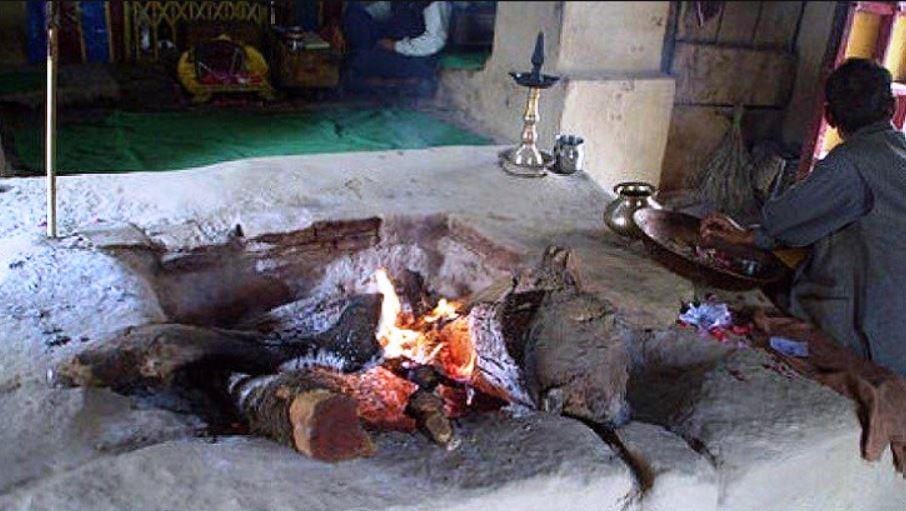
The havan kund in the temple courtyard holds the flame. Wood, ghee, barley, and sesame seeds are offered each day. Pilgrims take a pinch of ash as prasad, often for reasons that are personal rather than spoken, balance, continuity, and peace within family life.
What stays with you is not the ritual, but the quiet around it. No one insists. No one explains. You can stand there, sit for a while, or simply watch the fire breathe.
The Wedding of Shiva and Parvati
Triyuginarayan is widely regarded as the site of Shiva and Parvati’s marriage. The story survives here without embellishment.
According to tradition, Lord Vishnu took on the role of Parvati’s brother, overseeing the duties of the family. Lord Brahma served as the priest. Sages and deities gathered as witnesses. The marriage took place before the Akhand Dhuni, making the fire more than symbolic, a participant.
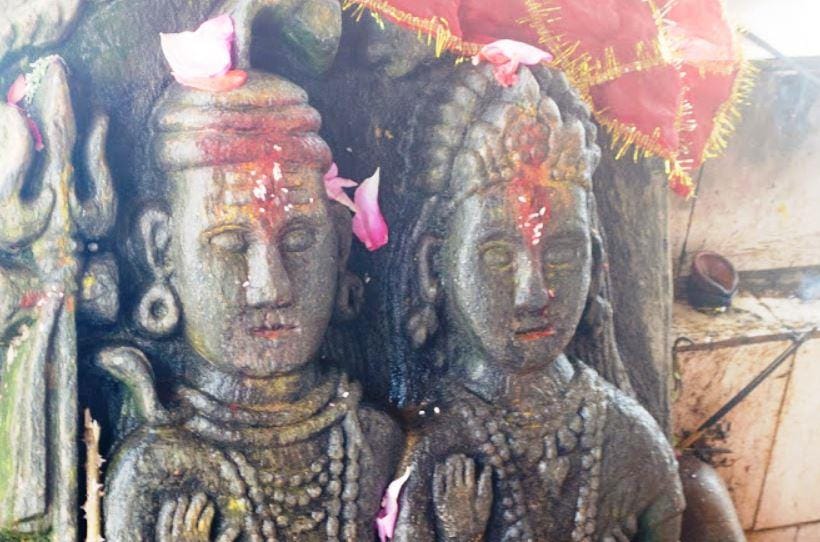
A stone placed in front of the temple, known as the Brahma Shila, is believed to mark the exact spot where the ceremony occurred. It sits quietly, without signage or drama, treated less like an object of display and more like a remembered point in the land.
Nothing here is staged. The story feels settled, as if it no longer needs to be told loudly.
The Sacred Kunds: Brahma, Vishnu, and Rudra
Just outside the temple are several small water kunds, each associated with a different presence:
- Brahma Kund
- Vishnu Kund
- Rudra Kund
- Saraswati Kund
Local belief holds that these waters were used by gods and sages before the wedding. The Saraswati Kund is said to originate from Vishnu’s navel.
Many pilgrims bathe here quietly. Some come with specific hopes related to family and continuity. Others step into the water without explanation. These beliefs are not advertised or insisted upon. They exist alongside the village, not above it.
Even without faith as a lens, the placement of water, temple, and daily life feels deliberately shaped by long use rather than design.
The Vamana Avatar and the King Bali Story
Inside the sanctum, Vishnu is worshipped in his Vamana avatar. For visitors expecting a purely Shiva-centric space, this often comes as a surprise.
The connection traces back to the story of King Bali, who was performing yajnas to claim Indra’s throne. When he had completed ninety-nine, Vishnu appeared as Vamana and asked for three steps of land. With two steps, the universe was covered. For the third, Bali offered his own head.
Tradition holds that this yajna was halted here, giving Triyuginarayan its association with Vamana. Idols of Lord Badrinath and Lord Ram are also present in the sanctum, quietly reinforcing the Vaishnav layer of the temple.
Nothing here contradicts itself. The space holds multiple strands without needing to resolve them.
Triyuginarayan Temple Uttarakhand: A Living Village
What gives Triyuginarayan its weight is not scale, but continuity. The temple exists inside a living village.
People stay here throughout the year. Fields are worked. Children walk past the temple on their way to school. Cows rest near the kunds. The sacred does not interrupt daily life; it moves alongside it.
Ancient texts describe Triyuginarayan as the capital of Himavat. Today, there is no trace of grandeur. The place feels grounded, unconcerned with attention, settled into its own rhythm.
How to Reach Triyuginarayan Temple
Triyuginarayan is commonly visited along with Kedarnath.
The Triyuginarayan to Kedarnath distance: The distance between Triyuginarayan and Kedarnath is roughly 27 to 33 kilometres, depending on the route you choose. There is no direct motorable road connecting the two shrines, so the journey is usually completed in two stages, combining road travel with a short trek or village path. Many pilgrims include it in their journey before or after Kedarnath Dham.
- By Road: The temple is 12 km away from Sonprayag. Sonprayag is well-connected by road. The Triyuginarayan temple is also accessed by trekking.
- By Train: Nearest railway station: Rishikesh (around 220 km)
- By Air: Nearest airport: Jolly Grant Airport, Dehradun (around 230 km)
Best Time to Visit Triyuginarayan Temple
- April to June: Comfortable weather, good road access
- September to November: Quiet and calm after the monsoon
- Monsoon: Monsoon months carry landslide risks
- Winter: Snowfall may limit access
Early mornings and late afternoons are the calmest.
Who Should Visit Triyuginarayan Temple?
I feel Triyuginarayan is a perfect place for pilgrims seeking depth beyond Kedarnath, couples curious about the Shiva–Parvati marriage tradition, and travellers interested in mythology without theatrics. It may not suit those expecting large temple complexes or quick sightseeing.
Final Thoughts
The Triyuginarayan Temple doesn’t demand belief. It allows it. The Akhand Dhuni burns quietly, the village lives around it, and the stories stay rooted in the land rather than floating as legends. Some places explain themselves loudly. Triyuginarayan waits for you to listen.